









AI Asset Inventory & Governance for Financial Institutions
Find AI models, agents and third-party tools across your organization. Then assess their risk and keep governance moving in one configurable register.

For AI governance, model risk, operational risk, compliance and technology risk teams.
What is an AI asset inventory?
An AI asset inventory is a maintained register of the AI systems and uses an organization relies on, including models, agents, applications and third-party tools. It connects each asset to an owner, business purpose, data access, risk assessment and lifecycle status.
For financial institutions, that visibility helps teams find unregistered AI, decide which uses need deeper review and document the controls applied. A model inventory may be one input, but it may not capture every agent, embedded vendor feature or business-built AI application.
AI adoption outpaces the inventory
Models developed by data science teams, agents built by business users, and AI features added to vendor tools can all enter use through different channels. When the inventory relies on self-reporting alone, teams may lack a reliable view of what is running, who owns it, and what it can access.
That visibility gap affects risks financial institutions already manage:
Financial and Customer Risk
AI used in lending, credit, or other consequential decisions may operate without the assessment and controls those uses require.
Operational Risk
Critical workflows may depend on AI systems whose owners, connections, or continuity plans have not been documented.
Data and Privacy Risk
Agents and third-party tools may access sensitive information without a clear record of their permissions or how that information is handled.
Reputational Risk
An AI error, biased outcome, or data incident can damage confidence when the institution cannot show how the system was reviewed and governed.
What should an AI inventory include?
Fields should follow your policy and risk methodology. These are useful starting points for each asset record:
Illustrative fields; institutions should tailor definitions and review thresholds to their own policies.
Visibility supports risk-based oversight
Requirements differ by jurisdiction, system and institutional role. These frameworks illustrate why a reliable record of AI uses and dependencies helps governance teams work.
EU AI Act
Obligations for certain high-risk AI systems include risk management, documentation and post-market monitoring. A broader inventory can help identify potential in-scope systems and route them for assessment; the Act does not require a universal enterprise-wide AI register for every organization.
Source: Regulation (EU) 2024/1689, including Articles 9, 11 and 72
DORA
In-scope financial entities must identify, classify and document information and communication technology (ICT)-supported business functions, information assets and ICT assets. DORA separately requires a register of information on contractual arrangements for third-party ICT services. Relevant AI systems and service dependencies should be assessed within the applicable ICT governance processes.
Source: Regulation (EU) 2022/2554, Articles 8 and 28
U.S. financial-sector guidance
The Financial Services AI Risk Management Framework adapts NIST’s AI framework for financial services. It offers a voluntary, risk-based resource for evaluating AI use cases and managing risk across the lifecycle; it is not a new statutory inventory mandate.
From discovery to ongoing governance
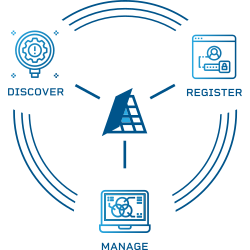
Apparity’s AI Asset Register gives teams a structured path from finding assets to managing the ones that need oversight.
1. Discover and register
2. Assess what matters
3. Govern over time
Configure the register to your risk program
Bring discovery, intake and governance actions together without forcing every AI use through the same review path.
Connected discovery
API integrations with Microsoft Copilot Studio and Azure AI Studio help surface assets in connected environments. Coverage depends on configuration and access.
Configurable asset registration
Capture owners, use cases, providers, data access, risk attributes, status and evidence in fields aligned to your policies.
Risk assessment workflows
Use questionnaires, scoring and materiality thresholds to route assets to the appropriate review.
Approvals and attestations
Assign action owners, record approvals and prompt periodic confirmation that inventory details remain current.
Reporting and audit trail
Review inventory coverage, risk tiers and outstanding actions; retain a record of assessments and governance activity.
Broader asset governance
Extend the same configurable inventory approach used for end-user computing (EUC) and other assets to AI use cases.
Built on experience with governed assets
Apparity applies its established discovery, registration and control workflows to AI assets in financial institutions.
One connected approach
Link AI inventory to broader EUC, model and digital asset governance on a configurable platform.
Financial-services focus
Set fields, review steps and materiality criteria around the risk processes used by banks, insurers and asset managers.
Trusted & secure
Apparity’s SOC 2 Type II attestation reflects the rigor of our security program and our commitment to maintaining the highest standards of trust and operational excellence.
Know what AI is in use—and what needs review.
See how Apparity can help your team discover assets, apply your risk framework and maintain a usable AI inventory.